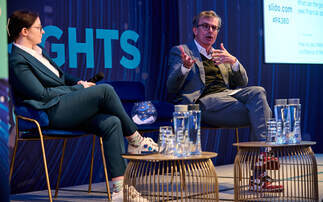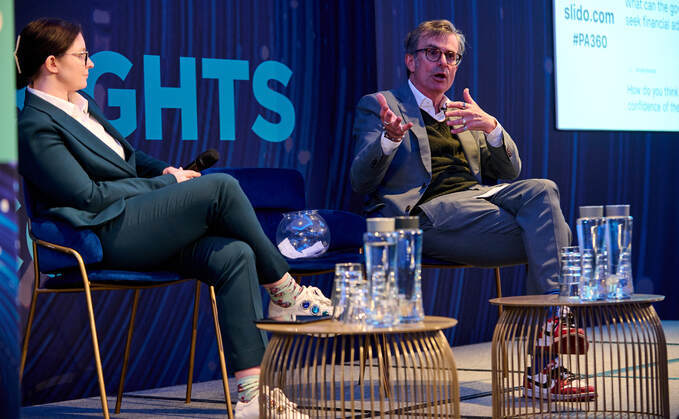
ITV political editor Robert Peston at PA360
At last week’s PA360, keynote speaker and ITV political editor Robert Peston spoke to Professional Adviser editor Jen Frost about how the conflict in the Middle East has impacted UK growth.
Since the 2008 recession, Peston acknowledged: "We have seen a whole succession of crises that have fundamentally reshaped the world."
There was Brexit, the first election of Donald Trump, the Covid-19 pandemic, Russia invading Ukraine, then a second Trump administration, a tariff shock, and now the conflict in the Middle East.
"The world is intrinsically much less stable than it had been over the previous 15 years," Peston stressed.
For the UK, this is "particularly problematic" as it has coincided with a period of low growth, meaning "we are living through volatile times".
The US and Israel launched strikes on Iran earlier this year, resulting in Iran launching attacks on the US and Israel-allied states in the Gulf.
Since then, Iran has closed the Strait of Hormuz, which provides a passage for around 20% of the world's oil and gas flows.
This has resulted in a shortage of oil and gas all over the world, including in the UK.
Peston said that while the shortage is not "the end of the world", it is "a cost of living crisis, and at the moment, it looks as though that is what it will remain as. But it is a bad one."
Meanwhile, "the American economy, in terms of growth, is barely affected by any of this".
"The war that only happened because Trump wanted it is hurting the rest of the world economically, at least way more than it's hurting America," Peston highlighted.
The war has impacted the UK's growth forecast, with Peston explaining the International Monetary Fund's forecast for UK growth has dropped as a result.
Additionally, tax revenue is predicted to be less than the government needs this year, inflation is likely to be higher than it would have been, and the country could see a rise in interest rates from the Bank of England.
Increasing growth in the UK
With the government hoping to get the growth rate up, Peston was critical of its strategy so far.
For example, while there were many reasons why the government may have wanted to change labour protections, they could have first tried to incentivise businesses to hire more people.
To raise the growth rate, Peston said he believed the focus should be on increasing investment and productivity.
"Investment in the UK, whether it's private or public, is well below the average of our major competitor countries," Peston stated.
The government is trying to combat this by reducing the cash ISA limit in 2027 from £20,000 to £12,000 a year. The remaining £8,000 will be tax-free in a stocks and shares ISA.
When thinking about investment, Peston continued that the government also has to think about productivity.
He said: "If you're going to target any statistic in the economy, it is the output per hour."
The output per hour determines what people can afford to pay themselves and their productivity.
According to Peston, productivity "fell off a cliff after 2007/8", with productivity in the UK lower than many of its major competitors.
For Q3 2025 the output per hour was recorded as 3.1%, a 1.1% growth, according to the Office for National Statistics, which was behind the US, Germany and France.
"Nobody is saying that getting productivity up or getting investment up is quick or easy," Peston noted, "but it's impossible, if that isn't your major focus".
For example, the government has recently been more focused on the Mandelson scandal rather than fixing these problems.
Moreover, Peston stressed: "There are fewer people at the top of government than in the past who really understand economics. That's a problem."
How AI will impact the economy
Peston also spoke about how artificial intelligence is likely to impact the economy, believing it presents both "enormous opportunity and a huge risk".
He acknowledged AI will eliminate a very large number of jobs, particularly entry-level jobs, which is already beginning to happen.
As more firms begin to implement AI, he warned: "Everybody will be under economic pressure, as it were, to adopt this stuff."
This will have significant implications.
With entry-level roles being eradicated, succession plans for firms will become harder to establish.
"If you're not hiring young people and training them up when you have decided you don't want to be in the business anymore, where are these people going to come from?" Peston asked.
The economy is also likely to be impacted as more people are replaced by AI.
As AI begins to take on a bigger role, more people will be out of work. When this happens, Peston questioned: "Who will pay income tax?
"How do people, if they're not in work - and there will be a period of transition when some people are not in work - how are they going to have income to be trained and to buy the stuff that these robots are going to be making?"
AI presents fundamental questions about the structure of the state, the structure of the welfare system, the structure of the tax system. However, these are not conversations the government is having.
"We're still not seeing leadership from government about how they're going to change these systems," Peston observed.
"This is all stuff that we've all got to think about."